Hydrogen is described in colors: green, blue, gray, and a few more. The colors can make it sound like several different fuels. They are not. The molecule is identical every time. The color describes how it was made, and that decides its climate footprint. On that measure, the International Energy Agency's Global Hydrogen Review 2026 is clear about where the world stands.
A huge market you rarely see
"Global hydrogen demand surpassed 100 million tonnes (Mt) in 2025, driven by growth in traditional sectors," the IEA reports, up almost 3 percent on the year. "Hydrogen use in industry and refining accounted for almost all demand in 2025." Most people never see hydrogen, but they eat its results. Making ammonia required around 34 Mt of hydrogen in 2025, and the majority of that ammonia went into fertilizers. Methanol production accounted for another 16 Mt.
The color code, decoded
The colors are shorthand used by industry and the press. Neither the IEA nor the U.S. Department of Energy defines hydrogen by color: the IEA speaks of "low-emissions" and "unabated fossil" hydrogen, and the DOE uses measured emissions. In common usage:
- Gray: made from natural gas, with the carbon dioxide released.
- Blue: made from natural gas, with carbon capture applied.
- Brown or black: made from coal.
- Green: water split by electrolysis using renewable electricity.
- Pink: electrolysis powered by nuclear energy.
- Turquoise: methane split into hydrogen and solid carbon. Still emerging.
- White: hydrogen found naturally underground. Early and largely unexplored.
How gray hydrogen is made
The workhorse is steam methane reforming. In the DOE's description, "methane reacts with steam under 3-25 bar pressure in the presence of a catalyst to produce hydrogen, carbon monoxide, and a relatively small amount of carbon dioxide," using steam at 700 to 1,000 degrees Celsius. It is mature, large scale, and cheap where gas is cheap. In the United States, "95% of the hydrogen produced" is made this way.
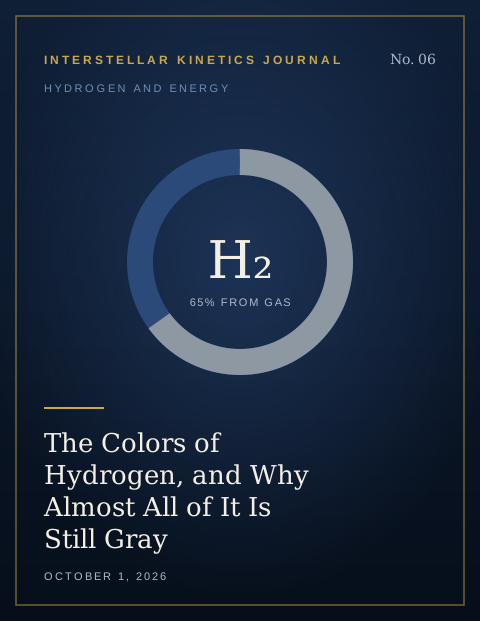
Worldwide, "almost 65% of hydrogen produced globally was produced from natural gas" in 2025. Coal is the other major feedstock: in 2024, the IEA counted 290 billion cubic meters of natural gas and 90 million tonnes of coal equivalent used to supply hydrogen.
Why almost all of it is still gray
Clean hydrogen is growing fast from a very small base. "Low-emissions hydrogen production grew by 20% in 2025 to reach almost 1 Mt," the IEA reports. Against a market of more than 100 Mt, that is under 1 percent, and the agency expects it to pass 1 percent of global production for the first time in 2026. Installed electrolysis capacity doubled in 2025 to more than 4 gigawatts.
The pipeline has thinned, though. New final investment decisions fell below 0.8 Mt a year in 2025, after two years at around 1 Mt. Projects committed or likely to operate by 2030 "declined from 10 Mt to just above 6 Mt" compared with the previous review, because investment decisions were delayed.
In the near term, low-emissions hydrogen production will remain more costly than fossil-based hydrogen in most parts of the world, apart from China.
Cost is the core obstacle. The IEA's 2025 review put renewable hydrogen at between 1.5 and 7 times the cost of unabated fossil hydrogen, depending on location, and its 2026 review sees renewable hydrogen in China possibly becoming cost competitive by 2030. The DOE's Hydrogen Shot program aims to cut the cost of clean hydrogen by 80 percent, to $1 per kilogram within a decade, from about $5 per kilogram for hydrogen made with renewable energy.
Measure carbon, not color
U.S. policy skips the palette and counts emissions. The DOE's Clean Hydrogen Production Standard sets a target of 4.0 kilograms of CO2 equivalent or less per kilogram of hydrogen, counted from the extraction of the feedstock to the plant gate. The DOE's own examples show why color can mislead: a gas reformer capturing about 95 percent of its carbon could reach about 4.0, and so could an electrolyzer drawing about 15 percent of its power from the grid. A "blue" plant and a "green" one can land on the same number, and an electrolyzer running on fossil heavy grid power can miss it entirely.
Reading hydrogen news
- Check whether a project has reached a final investment decision or has only been announced.
- Compare any project's output with the 100 Mt market. Most are small by that measure.
- Ask how the electricity for electrolysis is sourced, hour by hour if possible.
- Watch the cost gap. It decides how fast the share of clean hydrogen can grow.