Few tax breaks are as misunderstood as the home office deduction. Some people skip it out of fear that it invites an audit. Others claim a kitchen table they also eat at. The rules are narrower than the myths and more generous than the fears, and the IRS spells them out plainly in Publication 587.
The two tests every home office must pass
First, exclusive use. In the IRS's words, "you must use a specific area of your home only for your trade or business." It does not have to be a whole room, but the area has to be dedicated. Second, regular use. "Incidental or occasional business use is not regular use."
The space also has to qualify as your principal place of business, or a place where you meet clients, or a separate structure. For most online businesses the principal place test is the one that matters, and the law includes a helpful rule: a home office counts if you use it for administrative or management activities and "there is no other fixed location" where you do substantial administrative or management work. Publication 587's examples are ordinary ones: billing customers, keeping books and records, ordering supplies, and setting up appointments.
Two exceptions skip the exclusive use test entirely: space used to store inventory or product samples, and space used as a daycare facility, each under its own conditions.
Method one: simplified
The simplified method is a flat rate: "$5 per square foot of home used for business (maximum 300 square feet)." The most it can produce is $1,500 a year. A 200 square foot office, for example, works out to $1,000.
The trade off is simplicity. With this method you cannot deduct depreciation or actual home expenses for the office. Mortgage interest and real estate taxes stay personal, claimed in full on Schedule A only if you itemize. And if the deduction would exceed your business income, the excess is simply lost. It "may not be carried over."
Method two: regular
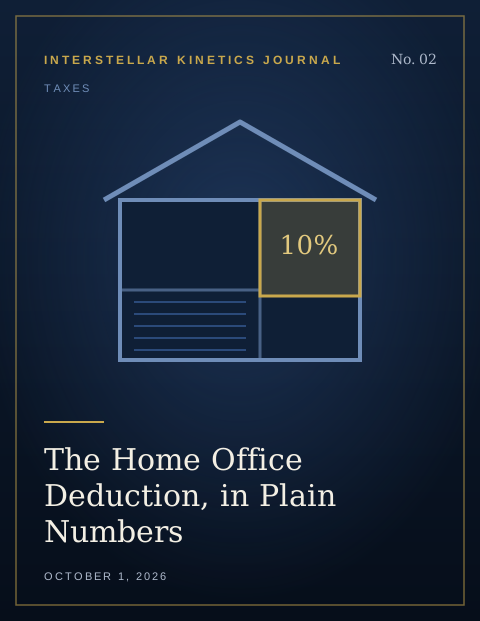
The regular method uses your actual costs. You start with your business percentage: "Divide the area (length multiplied by the width) used for business by the total area of your home." A 200 square foot office in a 2,000 square foot home is 10 percent.
Self-employed filers figure it on Form 8829. Direct expenses, which benefit only the office, such as painting that room, are deducted in full. Indirect expenses, which keep up the whole home, such as utilities and insurance, are multiplied by the business percentage. Homeowners also depreciate the business portion of the home itself.
Two rules keep this method honest. The deduction cannot be larger than the gross income from the business use of the home, though under the regular method the excess carries forward to the next year. And depreciation follows you to the sale. When you sell, "you cannot exclude the part of any gain equal to any depreciation allowed or allowable after May 6, 1997," even depreciation you never claimed.
You may choose to use either the simplified method or the regular method for any taxable year.
You can switch methods from year to year, but once you choose a method for a given year you cannot change it for that year.
The answer for W-2 employees
If you work a W-2 job and also run a business from home, the business may still qualify on its own, as long as the space meets the tests for that business.
Keep records the IRS expects
No particular format is required, but "you must keep records that provide the information needed to figure your deductions." In practice that means a measured floor plan or simple sketch, photos showing the space is used only for work, your expense records, and the documents that establish your home's basis if you use the regular method.
- Measure the space and the whole home once, and keep the numbers.
- Run both methods. The simplified one often wins for renters with small offices; the regular one often wins for owners with larger ones.
- Note the year you started business use. Depreciation and its effect on a later sale start there.
- These figures come from the IRS's 2025 revisions. Check the 2026 versions when they are published.