"Nine out of ten businesses fail." It is one of the most repeated lines in entrepreneurship, and you will not find it in federal data on new businesses. What you will find is a long, careful record kept by the U.S. Bureau of Labor Statistics, and it describes something less dramatic and more instructive.
The survival curve, year by year
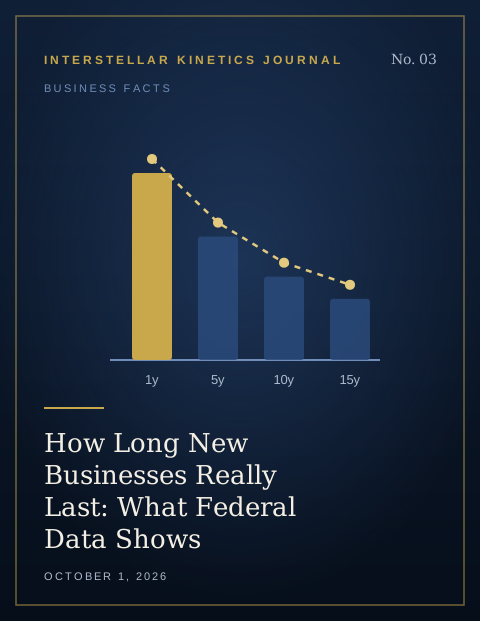
The BLS Business Employment Dynamics program follows each group of new private-sector establishments from the year it opens. Its latest table, with data through March 2025, shows how the most recent groups have fared:
- 1 year: of establishments that opened in the year ended March 2024, 77.9 percent were still operating a year later.
- 5 years: of those that opened in the year ended March 2020, 51.4 percent were still operating in 2025.
- 10 years: of the 2015 group, 34.7 percent were still operating.
- 15 years: of the 2010 group, 25.5 percent were still operating.
Behind the first figure are real counts: 769,449 of the 988,310 establishments that opened in the year ended March 2024 were still operating a year later. The oldest group BLS follows opened in the year ended March 1994, and 12.6 percent of those establishments were still operating in March 2025, 31 years on.
The long view is remarkably steady. Using the same BLS data, the SBA Office of Advocacy reports that from 1994 to 2022 an average of 67.7 percent of new employer establishments survived at least two years, and "the five-year survival rate was 49.2 percent, the ten-year survival rate was 33.9 percent, and the fifteen-year survival rate was 25.5 percent."
Survival rates for new business establishments vary from year to year due to several factors, including the business cycle, industry, and location.
Openings and closings run side by side every year. According to the SBA Office of Advocacy, "In 2023, 1.3 million business establishments opened for the first time, and about 1.2 million establishments closed permanently." Closures are a constant part of the picture, even in a year of growth.
Industry and timing matter
Averages hide real differences. Among establishments that opened in the year ended March 2020, 56.5 percent of construction establishments were still operating five years later, compared with 45.7 percent in the information sector. The gap holds at ten years: 42.6 percent for construction against 30.0 percent for information, with all private industries at 34.7 percent.
Timing matters too. Across 1994 to 2022, the lowest one-year survival rate BLS recorded by region was 71.4 percent, for South Atlantic establishments born in 2008, at the start of the Great Recession. The highest was 84.6 percent, for Pacific establishments born in 2021.
Read the fine print
Three details keep these numbers honest. First, BLS measures establishments, meaning single locations, not whole companies. "Whereas a firm would represent an entire business, an establishment affords data that offer a more granular look." A chain closing one store counts as an exit even though the company survives.
Second, an exit in this data means employment stopped: BLS counts an establishment as closed after four consecutive quarters with zero employment. It tracks businesses "despite changes in name or ownership," so a sale is meant to be linked rather than counted as a death. Federal data does not record why an establishment closed. A planned retirement and a bankruptcy look the same.
Third, these figures cover employer establishments only. According to the SBA Office of Advocacy, there are 36,207,130 small businesses in the United States, and 82.3 percent of them have no employees. Solo businesses are mostly outside these survival rates.
What it means if you are starting out
The useful reading of this data is neither fear nor false comfort. Roughly one in five new employer establishments does not reach its first anniversary, and about half reach their fifth. The first year is where the steepest drop happens, which is exactly why the earliest decisions about structure, cash, credit, and records carry so much weight.
- Plan for the first year as the hardest year, with cash to match.
- Compare yourself with your own industry, not the national average.
- Treat "90 percent fail" as a myth. The federal record says otherwise.