Most owners know their personal credit score to the point. Far fewer know that the business they formed has a credit file of its own, built and sold by commercial bureaus, scored on different scales, and open to anyone willing to pay for a copy. That file can decide whether a supplier ships on credit, whether a lender says yes, and how much of the risk lands back on you personally.
A different file, with different rules
The consumer protections most people associate with credit reports come from the Fair Credit Reporting Act. The Federal Trade Commission's staff summary of that law is direct about where it stops: a report about a person's business history, collected by a commercial reporting service solely for use in business transactions, "is not a 'consumer report.'"
That difference shows up in practice. Experian describes it this way in its own white paper on business credit: "Unlike personal credit reports, which are regulated and can be viewed only with the permission of the report holder, commercial credit reports are available to the public." There is also no business equivalent of AnnualCreditReport.com. Consumers can check their files from the three nationwide bureaus for free, and federal law guarantees a free annual copy on request. We found no federal rule giving businesses the same right.
Commercial credit reports are available to the public.
The three scores you are most likely to meet
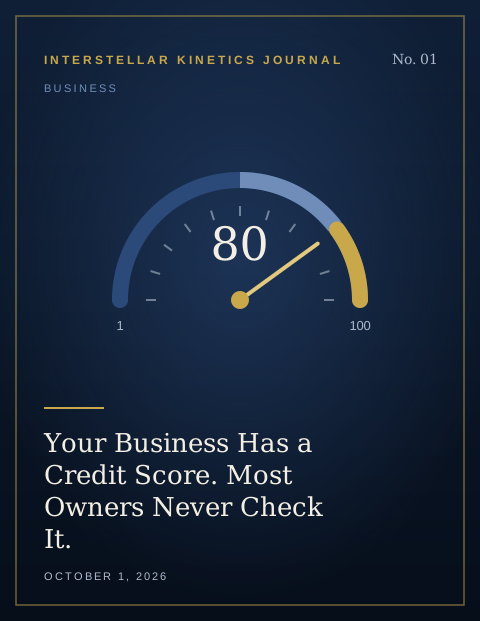
Dun & Bradstreet PAYDEX. PAYDEX runs from 1 to 100 and measures how promptly a business pays its suppliers, weighted by dollar amount. D&B groups 0 to 49 as high risk of late payment, 50 to 79 as moderate, and 80 to 100 as low. Its fact sheet explains what the numbers mean in days: 80 means payments "have generally been made within terms," 70 means about 15 days beyond terms, 50 means about 30 days beyond, and 100 means the business pays early.
There is a catch that surprises new owners. D&B will not calculate a PAYDEX for a business with fewer than three payment experiences, or with fewer than two suppliers reporting, and the experiences must fall within the last 24 months. A brand new company often has no PAYDEX at all.
Experian Intelliscore Plus. Also a 1 to 100 scale. Experian's user guide says it predicts the likelihood that a business becomes seriously delinquent, meaning more than 90 days beyond terms or bankrupt, within the next 12 months.
Equifax. Equifax's sample small business report shows several scores side by side, including a Credit Risk Score from 101 to 992 and a Payment Index from 0 to 100, where 90 or higher means "Paid As Agreed." Equifax sells other commercial scores as well, so treat those ranges as what appears on its sample report rather than a universal scale.
How your payments get on the file
Business credit is built from trade data: suppliers, lenders, and service providers telling a bureau how you paid. D&B is candid that this is voluntary. Companies "are not legally required to report Trade Payment Data," and vendors "do not report all of their Payment Experiences." In practice, paying on time is necessary but not sufficient. The payments also have to be with companies that report.
The usual first step is an identifier. A D-U-N-S Number from Dun & Bradstreet is free. In D&B's words, "There is no cost to request and receive a D-U-N-S Number," with a standard wait of up to 30 business days and a paid option that is faster.
Where your personal credit still comes in
Separating business and personal credit is a goal, not a switch. The FTC's staff report notes that a business credit application gives a lender a permissible purpose to pull the personal report of "an individual who will be personally liable for the debt," such as a guarantor. And for SBA lending, federal regulation sets the default plainly: "Holders of at least a 20 percent ownership interest generally must guarantee the loan."
Why it matters now
Credit is not easy to get. In the Federal Reserve Banks' most recent Small Business Credit Survey, 38 percent of employer firms applied for a loan, line of credit, or merchant cash advance in the prior 12 months. Of those applicants, 42 percent received the full amount they sought, 36 percent received some or most of it, and 22 percent received none. A clean, established business file is one of the few parts of that equation an owner controls in advance.
- Get a free D-U-N-S Number and confirm your business details match everywhere.
- Open trade accounts with suppliers that report, and pay inside terms. Early is better than on time for PAYDEX.
- Check what each bureau shows before you apply for anything. Errors on a business file are yours to find.
- Read every personal guarantee before you sign it. It is a promise of your own assets.